
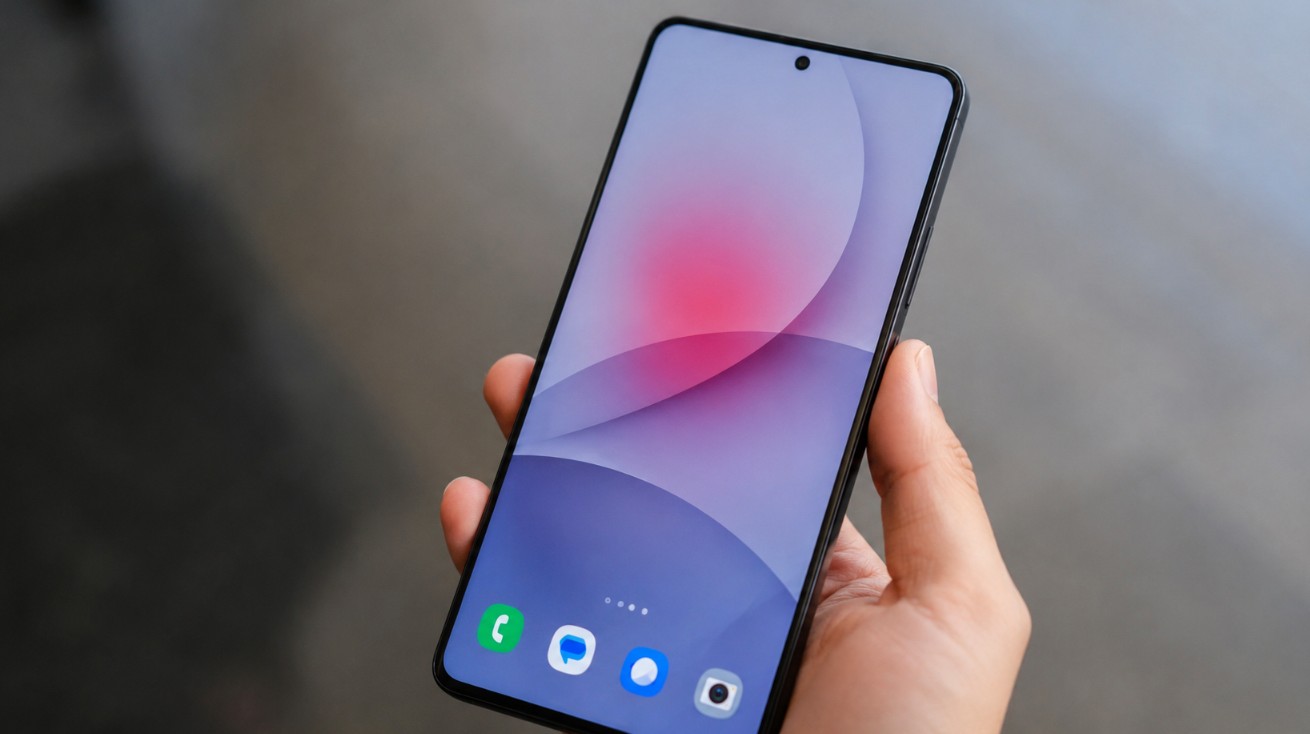
A growing number of Galaxy S26 Ultra owners say a red or pink patch is appearing near the center of their screens, giving Samsung another display problem to investigate on its most expensive mainstream phone.
The discoloration does not look like a normal warm screen setting. Photos shared by owners show a concentrated reddish area that remains in roughly the same part of the display as apps, images and menus change underneath it.
Some users say the phone looked normal when it was new and developed the tint gradually. Others have reported seeing a similar mark on demonstration units inside stores.
Samsung has confirmed that it is examining the complaints, but the company has not identified the cause, announced a recall or said how many phones may be affected.
What the Samsung Galaxy S26 Ultra Defect Looks Like?
The reports describe a red patch spreading across the middle of the OLED panel. It can be easier to see against white, gray and other light-colored backgrounds.
Owners say changing the brightness, screen mode or white balance does not remove the mark. The affected area also remains visible when different content is displayed, suggesting that the problem may be connected to the screen itself rather than one app.
Android Police reported that complaints have appeared across Reddit, Korean online communities and Samsung forums. The issue does not appear identical on every phone, and plenty of S26 Ultra owners have not reported any unusual tint.
Photos of screens can be misleading because cameras adjust exposure, color and white balance. A faint tint may look stronger in a photograph than it does in person. The repeated reports and Samsung’s investigation make the problem more difficult to dismiss as a camera artifact.
Samsung Is Still Trying to Find the Cause
Samsung has said it is reviewing affected devices internally. No technical explanation has been provided.
Several theories are circulating. Some users suspect uneven OLED aging. Others believe an adhesive, display layer or component beneath the panel may become visible after heat and regular use.
The Galaxy S26 Ultra’s new Privacy Display has also attracted attention. Samsung describes it as the first built-in mobile privacy display, capable of hiding the full screen, specific apps, notifications or passwords from people looking from the side.
The technology changes how light leaves the panel through modifications at pixel level. That makes the S26 Ultra display more complex than a standard smartphone OLED screen.
A connection between Privacy Display and the red patch is possible, but it has not been proven. Samsung has not blamed the feature, and turning privacy mode off reportedly does not make the red area disappear.
The Red Patch Is Not the First Complaint About the S26 Ultra Screen
The red discoloration arrives after months of debate about the Galaxy S26 Ultra display.
Some early buyers reported fuzzy-looking text, reduced clarity, eye strain and headaches. Several said they noticed discomfort even when Privacy Display was disabled. Other owners had no problems and considered the screen one of the phone’s strongest features.
The device also faced criticism over color depth. Samsung promoted advanced 10-bit color processing, but the physical panel is an 8-bit display that uses Samsung’s image processor to reproduce a wider range of color.
That does not automatically make the screen poor. Many buyers would still expect clearer language when a phone is sold as an Ultra model at a premium price.
The new red patch is more serious than a disagreement over specifications or color tuning. A fixed area of discoloration can indicate a physical panel problem, especially when it becomes stronger over time.
Samsung Has Dealt With Similar Screen Problems Before
Samsung has a long reputation for producing some of the best OLED displays in the smartphone market. It also has a history of occasional panel problems that appeared after devices reached customers.
Galaxy S20 owners reported a green tint that became noticeable at low brightness and higher refresh rates. Samsung later addressed that problem through a software update, showing that an alarming color change can sometimes be corrected without replacing the display.
The Galaxy S24 Ultra faced complaints about washed-out colors and grainy or sandy-looking textures, especially on dark gray backgrounds. Samsung adjusted some color controls through software, but users continued to debate whether the grain was a normal OLED characteristic or panel inconsistency.
@newtechunbox #samsung #s24ultra #samsungs24ultra #samsunggalaxy #samsungnews #technology #techtips #techtok #fy ♬ original sound – 💻 New Tech Unbox📱
Green vertical lines have appeared on several Galaxy generations, including models from the S21, S22 and S23 families. In some markets, Samsung offered eligible owners a one-time display replacement after inspection.
Those earlier cases do not prove that the Galaxy S26 Ultra defect has the same cause. They do show why owners are waiting to hear whether Samsung sees the new problem as a software fault, an isolated production batch or a wider hardware weakness.
How Owners Can Check Their Galaxy S26 Ultra?
A red patch may be easier to identify by displaying plain backgrounds at different brightness levels.
Owners can open white, light gray and dark gray images, then view them with Eye Comfort Shield, Adaptive Color Tone and Privacy Display switched off. A general warm color across the entire screen may come from a setting. A fixed red area that remains in one position is more concerning.
Taking a screenshot can help separate a software problem from a physical screen problem. Open the screenshot on another phone, tablet or computer. If the red patch does not appear on the second device, the S26 Ultra panel is the likely source.
Owners should photograph the display in neutral lighting and keep a record if the patch grows. The software version, purchase date and approximate time when the discoloration first appeared may also help during a warranty claim.
A Factory Reset May Not Be Worth the Trouble
Customer support may ask users to restart the phone, install updates or test Safe Mode. Those are reasonable early steps because they can rule out a temporary software or app problem.
A factory reset is unlikely to repair a physical OLED defect. Owners should back up their data before attempting one and should not erase the phone repeatedly when a fixed patch remains visible across every screen.
People within a retailer’s return or exchange period should report the problem before that window closes. Others should contact Samsung or an authorized service center and request a display inspection under warranty.
The Biggest Question Is How Widespread the Defect Becomes
Current reports do not show that every Galaxy S26 Ultra is defective. They also do not establish that the entire Privacy Display design is flawed.
The next step depends on what Samsung finds. A software-related color problem could be corrected through an update, as happened with the Galaxy S20 green tint. A defective display layer would probably require panel replacements and could become expensive if a large production batch is involved.
Samsung built much of the Galaxy S26 Ultra’s identity around its display. Privacy Display was presented as a practical feature that competing phones could not match. Any defect connected to that technology would turn one of the phone’s main selling points into its most uncomfortable weakness.
For now, owners should not panic over a slight change in overall screen warmth. A concentrated red patch that stays in place, survives every settings change and becomes more visible over time deserves to be documented and inspected.
Samsung’s investigation will need to answer three basic questions: what causes the discoloration, how many phones are affected and whether owners will receive a software fix or a replacement screen.
Also Read: Rumors about S 27 series.