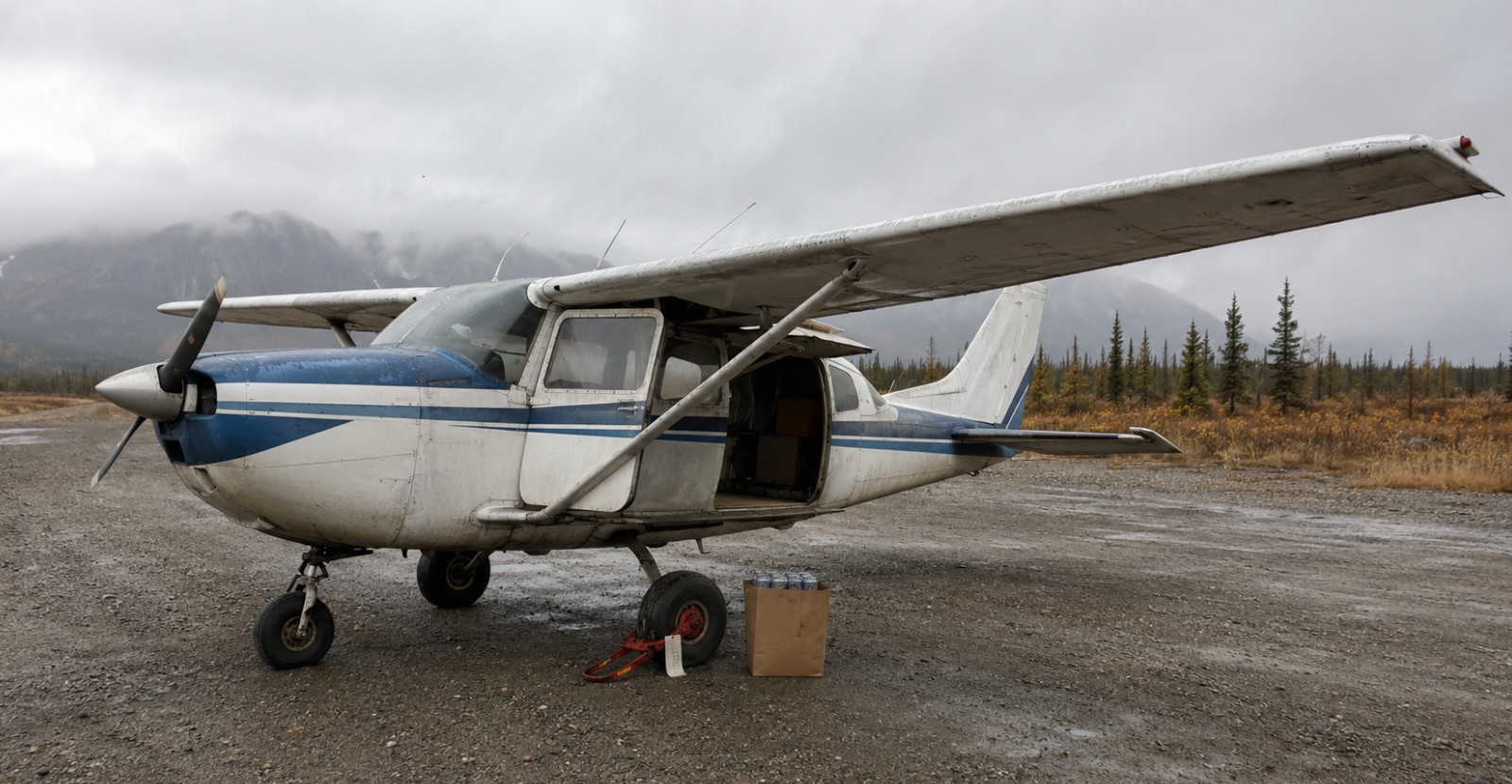
A six-pack of beer usually costs less than $15. Alaska says one visible inside a passenger’s baggage can help justify taking a pilot’s $95,000 airplane.
That dispute is now going to the U.S. Supreme Court.
The justices agreed on Monday to hear the case of Kenneth Jouppi, an 82-year-old former Alaska bush pilot who has spent more than a decade fighting the state’s attempt to confiscate his 1969 Cessna U206D.
The case has an irresistible headline, but the complete story is more complicated than six beers sitting in a plane. Jouppi’s passenger was carrying 72 cans of beer packed among her groceries. The flight was bound for Beaver, a remote Alaska village where the importation, sale and possession of alcohol had been prohibited.
Jouppi maintained that he did not know the full cargo included three cases of beer. A court later found that he had been willfully blind to one six-pack that troopers said was clearly visible.
He was convicted of a misdemeanor, spent three days in jail and received a financial penalty. Alaska then pursued the punishment that has kept the case alive since 2012: permanent forfeiture of the airplane he used for his small air-taxi business.
The Beer Belonged to Jouppi’s Passenger
Jouppi owned KenAir LLC and flew passengers to communities that could not easily be reached by road. On April 3, 2012, he was preparing to carry a woman and her groceries about 110 miles from Fairbanks to Beaver.
The beer was reportedly intended for the passenger’s husband, who worked in Beaver as the local postmaster. She had packed two cases of Budweiser and one case of Bud Light.
Alaska State Troopers searched the aircraft before takeoff. They said a six-pack was visible at the top of a grocery bag, with the rest of the alcohol packed among the passenger’s belongings.
The passenger pleaded guilty. Jouppi and his company went to trial, where a jury convicted them of knowingly transporting alcohol intended for a community that had banned it.
No beer ever reached Beaver because troopers intercepted the cargo in Fairbanks. Attempting to transport the alcohol was still enough to support the charge under Alaska law.
Jouppi received 180 days in jail with 177 suspended, leaving him to serve three days. The court imposed a $3,000 fine with half suspended. KenAir received a separate $10,000 fine with $8,500 suspended. Both were placed on probation for three years.
A trial judge noted that Jouppi had a clean criminal record and imposed the minimum period of incarceration. That could have ended the case.
Alaska wanted the airplane too.
Why Alaska Considers the Offense Serious?
Calling the case a fight over a six-pack risks making Alaska’s position sound absurd before its lawyers have been heard.
Many remote Alaska communities allow residents to decide through local elections whether alcohol can be sold, imported or possessed. Beaver adopted a complete prohibition in 2004.
The state argues that alcohol smuggling into isolated communities causes damage far beyond the retail value of the drinks. Alcohol misuse has been connected to violence, accidental deaths, chronic illness and fetal alcohol spectrum disorders. Medical care and law enforcement can also be difficult to reach in villages separated from the state’s road system.
Small aircraft are often the only practical way to move people and cargo into those communities. Alaska therefore treats an airplane used for bootlegging as more than transportation. In the state’s argument, it is the essential tool that makes the offense possible.
The Alaska Supreme Court accepted that reasoning in April 2025. Its unanimous opinion concluded that forfeiting Jouppi’s plane would not be grossly disproportionate to the seriousness of the offense.
The court placed considerable weight on the broader damage caused by alcohol in rural Alaska. It also concluded that the state legislature deliberately chose severe penalties to deter pilots from carrying alcohol into dry villages.
Jouppi Says the Court Judged a Social Problem Instead of His Conduct
Jouppi’s attorneys do not dispute that Alaska has serious problems involving alcohol in remote communities. Their argument is that a court deciding whether a punishment is excessive must look closely at what the individual defendant actually did.
Jouppi was not convicted of operating a large bootlegging organization. The beer belonged to a passenger, and courts did not find that he knew about all 72 cans. The finding against him concerned his failure to acknowledge the six-pack visible in the baggage.
His legal team says Alaska’s highest court moved too quickly from his individual conduct to the statewide consequences of alcohol misuse. Once the case was framed around alcoholism, crime and public health, almost any forfeiture could appear reasonable.
The Supreme Court docket for Jouppi v. Alaska shows that his attorneys asked the justices to decide how specifically courts must examine an offense when measuring a financial punishment.
Put more simply, should judges evaluate the man and the six-pack in front of them, or may they justify the punishment by considering every social harm connected to illegal alcohol in Alaska?
The Plane Is Legally Being Treated as A Fine
Property forfeiture allows authorities to seize assets connected to illegal activity. Cars, cash, homes, boats and aircraft can all become targets.
Forfeiture cases often produce strange-sounding disputes.
We previously covered a New York resident’s effort to recover a pet alligator seized by state officers. Jouppi’s case involves a more traditional piece of property, but the financial consequences are much larger than his original fine.
The Alaska Supreme Court agreed that taking the Cessna would count as punishment and therefore qualify as a “fine” under the Eighth Amendment. The disagreement concerns the next question: Is it excessive?
The Constitution prohibits excessive fines but does not provide a dollar formula. Supreme Court precedent says a financial punishment becomes unconstitutional when it is “grossly disproportional” to the gravity of the offense.
That sounds straightforward until a court must decide what belongs on each side of the comparison.
Jouppi wants the justices to compare a $95,000 airplane with his personal role in one failed attempt to transport beer. Alaska wants them to consider the plane as the instrument of a crime that creates serious risks in places where aircraft are often the only available supply route.
A Supreme Court Ruling Could Reach Far Beyond Alaska
The case will matter even to people who have never visited Alaska, flown in a Cessna or lived in a community with alcohol restrictions.
State and local agencies across the country use forfeiture laws to take property associated with criminal offenses. Critics have long argued that the system can produce punishments bearing little relationship to the crime, particularly when the seized property is far more valuable than the maximum ordinary fine.
The Supreme Court ruled in 2019 that the Eighth Amendment’s protection against excessive fines applies to state and local governments. That decision involved an Indiana man whose $42,000 Land Rover was seized after a drug offense involving a much smaller amount of money.
The justices did not fully explain how lower courts should measure excessiveness in every case. Different courts have since placed different levels of importance on the defendant’s actual conduct, the maximum legal penalty, the value of the property and the broader harm associated with the offense.
Jouppi’s case gives the court a chance to provide a clearer test.
A ruling for Jouppi would not prevent Alaska from prosecuting alcohol importation. It could require courts to examine the amount involved, the defendant’s knowledge, criminal history and individual circumstances before approving a major forfeiture.
A ruling for Alaska could give governments more room to defend expensive seizures by pointing to the general social harm connected with a category of crime.
The Dispute Has Already Lasted Longer than Jouppi’s Flying Career Did Afterward
More than 14 years have passed since troopers found the beer. Jouppi is now in his 80s, KenAir has been dissolved and he has retired from flying.
The plane has become something larger than a business asset. It now represents a basic question about punishment: At what point does enforcing the law turn into taking far more than the offense can reasonably support?
Arguments are expected during the Supreme Court’s coming term, with a decision likely by the summer of 2027. Until then, the most valuable six-pack in American legal history remains attached to a $95,000 airplane that never left the ground.