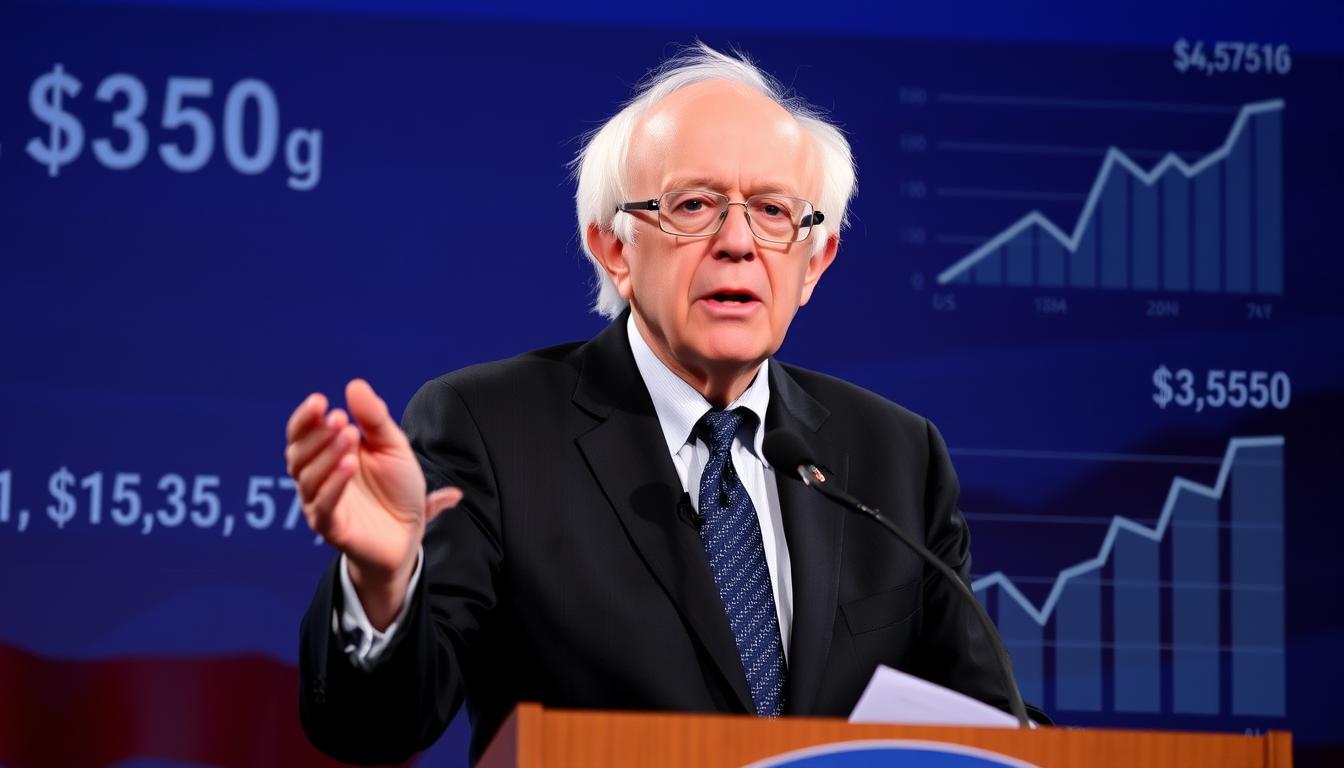
Bernie Sanders has spent much of his career attacking billionaires, corporate power and America’s widening wealth gap. He is also a millionaire.
Both facts are true, and the explanation is far less mysterious than social media makes it sound.
Bernie Sanders’ net worth is estimated at between $2 million and $3 million in 2026. Most of the money can be traced to three properties, retirement accounts, decades of congressional pay and a highly profitable run of political books after his 2016 presidential campaign.
The important word is “estimated.” Senate disclosures report assets in wide ranges rather than exact balances. Personal homes are not listed like ordinary investments, and calculating the present value of a future congressional pension requires some guesswork.
A financial tracker looking only at reportable accounts can place Sanders closer to $1.2 million. A broader calculation that includes property equity and other personal assets lands between $2 million and $3 million.
Sanders is wealthy by normal American standards. He is nowhere near the billionaire class targeted by his tax proposals.
- Estimated net worth in 2026: $2 million to $3 million
- Age: 84
- Senate salary: $174,000 per year
- Main income sources: Government salary, book royalties, property and retirement accounts
- Properties owned: Three
- Political affiliation: Independent who caucuses with Democrats
- Current office: U.S. senator from Vermont
- Current term ends: January 2031
Bernie Sanders Is Worth an Estimated $2 Million to $3 Million in 2026
That range includes his financial accounts, retirement assets, book income and likely equity in three homes. It avoids pretending that a Senate disclosure form provides a neat personal balance sheet.
An analysis of his latest publicly parsed annual disclosure estimated his trackable wealth at about $1.2 million. That narrower calculation does not fully capture personal property, pension value or every jointly held asset.
The disclosure listed several accounts with values reported in broad bands:
| Reported Asset | Disclosure Range |
|---|---|
| North Country Federal Credit Union | Up to $250,000 |
| VALIC Fixed Account Plus | Up to $250,000 |
| U.S. Federal Credit Union | Up to $100,000 |
| U.S. Senate Federal Credit Union | Up to $100,000 |
| TIAA Traditional Annuity | Up to $100,000 |
The maximum numbers cannot simply be added together. An account reported in a range reaching $250,000 may contain considerably less.
Sanders also has no large collection of publicly traded stocks visible to congressional trading trackers. That is unusual in a Congress containing active investors, business founders and heirs to major fortunes.
His financial setup is surprisingly uneventful. Credit-union accounts, annuities, property, books and public-sector income explain most of it.
He Became Wealthy Late in Life
Sanders did not spend his younger years building a company, collecting stock options or buying apartment buildings. He worked in politics, first as mayor of Burlington and later in the House and Senate.
National fame changed his finances.
Sanders was already 74 when his 2016 presidential campaign turned him into one of America’s most recognizable politicians. Millions of people suddenly knew the white hair, Brooklyn accent, raised finger and permanently impatient expression.
That attention created a large audience for his books.
Sanders and his wife Jane reported income exceeding $1 million in both 2016 and 2017. Their adjusted gross income dropped to $561,293 in 2018, but book royalties still supplied $391,000.
The couple’s released tax returns showed approximately:
- 2016 book income: $840,485
- 2017 book income: $855,631
- 2018 book income: $391,000
That is more than $2 million in publishing income across three years, before taxes and related expenses.
Sanders responded to questions about his newfound millionaire status with a blunt line:
“I wrote a best-selling book. If you write a best-selling book, you can be a millionaire, too.”
The answer irritated his critics, but the basic explanation was correct. He did not uncover oil beneath Burlington. He sold a large number of books after nearly winning a presidential nomination.
His Books Became a Lucrative Second Career
Sanders has written several books about economic inequality, healthcare, labor power, elections and American capitalism.
His best-known titles include:
- Our Revolution: A Future to Believe In
- Bernie Sanders Guide to Political Revolution
- Where We Go from Here: Two Years in the Resistance
- It’s OK to Be Angry About Capitalism
The publishing income did not end after the 2016 campaign. His latest examined disclosure listed another $148,750 from Penguin Random House.
That royalty payment came close to matching his entire annual Senate salary.
Members of Congress face restrictions on many forms of outside income, but book royalties are treated differently. A politician with a national following can legally turn speeches, policies and campaign stories into a profitable publishing operation.
Sanders did exactly that. He became wealthy by selling books about why a small group of people controls too much wealth. The irony is hard to miss, but irony is not evidence of corruption.
Decades of Congressional Pay Built the Foundation
Sanders entered the House of Representatives in 1991 and moved to the Senate in 2007. By 2026, he has spent more than 35 years in Congress.
A rank-and-file senator receives $174,000 per year. Congressional salaries were lower during the early part of his career, but decades of dependable six-figure pay created a strong financial base.
Gross salary is not personal wealth. Taxes, mortgages, daily expenses and campaign travel still have to be paid. Sanders’ total congressional earnings nevertheless run into several million dollars.
His long public career also created retirement benefits. Sanders has participated in federal retirement systems and holds a Thrift Savings Plan, the government equivalent of a workplace retirement account.
One recent disclosure listed a $6,221.52 City of Burlington pension payment connected to his time as mayor.
That payment will not transform his finances. It is still an amusing detail. Even the man demanding a political revolution remembers to collect his municipal pension.
Yes, Bernie Sanders Really Owns Three Homes
The phrase “socialist with three houses” has followed Sanders for years because it fits perfectly inside an angry social-media post.
The underlying claim is true. The suggested image of a sprawling luxury-property empire is not.
Sanders and his wife own a primary residence in Burlington, a row house in Washington and a seasonal home on Lake Champlain. The three properties originally cost approximately $1.47 million combined.
The Burlington Home
The couple purchased their main Burlington residence in 2009 for $405,000.
Book income reportedly allowed them to pay off the mortgage early. Rising property values mean the house is probably worth considerably more than its original purchase price, although an exact current valuation would be guesswork without a recent sale.
The Washington Row House
Sanders bought a Washington, D.C., row house in 2007 for approximately $489,000, around the time he entered the Senate.
Owning a residence near the Capitol is hardly unusual for a senator who has worked in Washington for decades. The property may also represent a substantial portion of his home equity because Washington prices have increased since 2007.
The Lake Champlain Property
The most controversial purchase came in 2016 when Bernie and Jane bought a four-bedroom seasonal home in North Hero, Vermont, for $575,000.
The property has more than 500 feet of Lake Champlain shoreline. That sounds luxurious, although images show a Vermont lake house rather than a billionaire’s private compound.
Jane Sanders said the purchase became possible after her family sold a Maine property it had owned for generations. Reporting from the time of the purchase supports that account.
The three properties serve three clear purposes:
- The Burlington house is the couple’s main home.
- The Washington property provides a residence near Sanders’ job.
- The North Hero property is a family vacation home.
Owning three homes is a major financial advantage. Most Americans will never have that option. It still does not make Sanders a real estate tycoon.
Campaign Money Is Not Part of Sanders’ Net Worth
A persistent mistake in political wealth stories is treating campaign funds as a candidate’s personal money.
Sanders’ political organization reported approximately $22.9 million in cash after the first quarter of 2026. It raised roughly $1.9 million during the quarter, entirely from individual donors.
Bernie Sanders cannot use that money to pay his mortgage, buy a car or add another house beside Lake Champlain.
Campaign funds are regulated. They can be spent on employees, advertising, travel, events, fundraising and other approved political costs. They cannot be transferred into a politician’s personal savings account.
The balance proves that Sanders remains an exceptional fundraiser. It does not make him $22.9 million richer.
His political success affected his personal wealth indirectly. The campaigns produced fame, and fame sold books. The campaign account itself belongs to the political organization.
Sanders Is Rich Compared With Most Americans
There is no honest way to describe Sanders as financially ordinary.
The most recent Federal Reserve Survey of Consumer Finances placed median American household net worth at approximately $192,700. Among households headed by someone aged 75 or older, the median was about $334,700.
| Comparison | Estimated Net Worth |
|---|---|
| Median U.S. household | $192,700 |
| Median household aged 75 or older | $334,700 |
| Bernie Sanders | $2 million to $3 million |
| Minimum billionaire fortune | $1 billion |
A $2.5 million fortune is more than seven times the median wealth of an American household in Sanders’ age group.
The comparison with a billionaire is much more dramatic. Someone worth $1 billion has 400 times as much money as someone worth $2.5 million. A person worth $100 billion has 40,000 times as much.
“Millionaire” and “billionaire” sound like neighboring descriptions. Financially, they are separated by an enormous distance.
He Is Not Among the Senate’s Great Fortunes
Several million dollars is relatively modest inside the United States Senate.
Congress includes business founders, investors, wealthy spouses and heirs. Several senators have reported fortunes above $100 million.
Sanders sits nowhere near that group. A 2026 tracker ranked him around 316th among all members of Congress based on publicly visible financial assets.
His finances also lack the volatility seen in business-linked political fortunes. Compare his collection of credit-union accounts and book royalties with Donald Trump’s mix of real estate, company shares and cryptocurrency interests. Sanders’ balance sheet looks almost deliberately dull.
Dull can be good. It means fewer questions about secret investors, unusual stock trades and hidden corporate interests.
Does Being a Millionaire Make Sanders a Hypocrite?
Critics see a simple contradiction. Sanders attacks wealth inequality, owns three homes and has millions of dollars.
Supporters reply that his policies target concentrated billionaire power, corporate tax avoidance and worker exploitation. They do not target every retired couple with property, savings and a successful book deal.
The second argument is closer to his policy record.
Sanders has never proposed taking every dollar a person owns above $1 million. His most aggressive plans concentrate on billionaires, enormous estates, corporations and extremely high annual incomes.
In 2026, Sanders introduced a proposal for an annual 5% tax on billionaire wealth. The plan was projected to raise $4.4 trillion over ten years for direct payments, healthcare, teacher salaries and housing. The proposed tax would apply to roughly 1,000 billionaires.
Sanders later proposed a one-time stock tax on the largest artificial-intelligence companies. The money would create a public wealth fund with the potential to support healthcare, housing, education and annual payments. The AI proposal would give the public ownership in major technology businesses rather than leaving all future gains with founders and investors.
Neither proposal would come close to applying to Sanders.
At an estimated $2.5 million, his fortune represents approximately one-quarter of one percent of the minimum needed to be a billionaire.
His Tax Returns Told the Main Story
Sanders released ten years of tax returns during his 2020 presidential campaign.
The documents showed the household’s post-2016 income surge, the publishing source of that money and the taxes paid. Sanders and his wife reported a 26% effective federal tax rate in 2018.
Senate financial disclosures provide more recent information, but they come with serious limitations. An asset might be listed between $50,001 and $100,000, leaving readers unable to determine the exact balance.
Personal residences are also treated differently from income-producing investments. A database relying entirely on Senate forms may therefore understate the wealth of a person with substantial home equity.
No credible public evidence shows that Sanders accumulated a hidden corporate fortune or became wealthy through unusually successful stock trading.
The public record tells a much simpler story:
- He received congressional pay for more than three decades.
- His family purchased property that increased in value.
- He accumulated pensions and retirement accounts.
- His presidential campaigns made him internationally famous.
- That fame generated bestselling books and large royalties.
The Financial Controversies Around the Sanders Family
Sanders’ finances have produced endless political arguments but little evidence of improper personal enrichment.
The Three-House Attack
Owning three homes remains the easiest criticism to make.
The claim is factually correct, but photographs used to support it are not always genuine. One popular post showed a large Vermont mansion that Sanders never owned. The property in that viral image belonged to someone else.
His real homes are valuable. None is the multimillion-dollar estate circulated in the false post.
Jane Sanders and Burlington College
Jane Sanders faced federal scrutiny over a land purchase made during her time as president of Burlington College. Questions centered on fundraising commitments used to support financing for the transaction.
The college later closed under heavy debt. Federal prosecutors ended the inquiry without bringing charges against Jane Sanders. The investigation concluded without criminal charges.
The episode damaged her reputation and remains a regular political talking point. It did not establish that Bernie Sanders personally profited from the college’s finances.
The Australian Volunteer Penalty
Sanders’ 2016 campaign paid a $14,500 civil penalty after Australian Labor Party volunteers received stipends and travel expenses while helping the campaign.
Federal law prohibits foreign nationals from supplying something of value in connection with an American election. The campaign said staff members did not believe the volunteers’ stipends changed their legal status and settled the dispute.
The Federal Election Commission record confirms the penalty. It was a campaign-compliance case, not evidence that Sanders took the money personally.
At 84, Sanders Is Still Raising Money and Shaping Policy
Sanders won a fourth Senate term in 2024 with 63.2% of the vote. Vermont’s official election results recorded 229,429 votes for Sanders, more than twice the total received by Republican Gerald Malloy.
His term runs through January 2031, when he will be 89.
Another presidential campaign appears extremely unlikely. Sanders has pointed to his age when questioned about running in 2028.
Retirement from presidential politics has not ended his national influence. His “Fighting Oligarchy” events, media appearances and economic proposals continue to attract large audiences.
That visibility also preserves his value as an author. Sanders no longer needs to run for president to sell a political message or another book.
My Take on Bernie Sanders’ $2 Million to $3 Million Fortune
Bernie Sanders is a millionaire. Pretending otherwise would be ridiculous.
Calling him a financial fraud simply because he has a few million dollars also misses the scale of his political argument.
His fortune came mainly from decades of government pay, rising property values, retirement accounts and books purchased voluntarily by readers. The largest jump arrived after Sanders was already in his seventies.
The three homes are politically awkward. A lakefront property does not sit neatly beside speeches about families struggling to afford rent. Sanders and his supporters should be able to admit that without producing elaborate excuses.
Scale still matters. A person worth $2.5 million is rich by everyday standards but almost irrelevant beside a billionaire. Sanders could multiply his fortune by 100 and still possess only one-quarter of a billion dollars.
The truth is less dramatic than either political side wants.
Bernie Sanders became a millionaire because he spent decades earning a congressional salary, bought property that appreciated and wrote bestselling books after becoming internationally famous.
That is capitalism, and the democratic socialist turned out to be rather good at it.