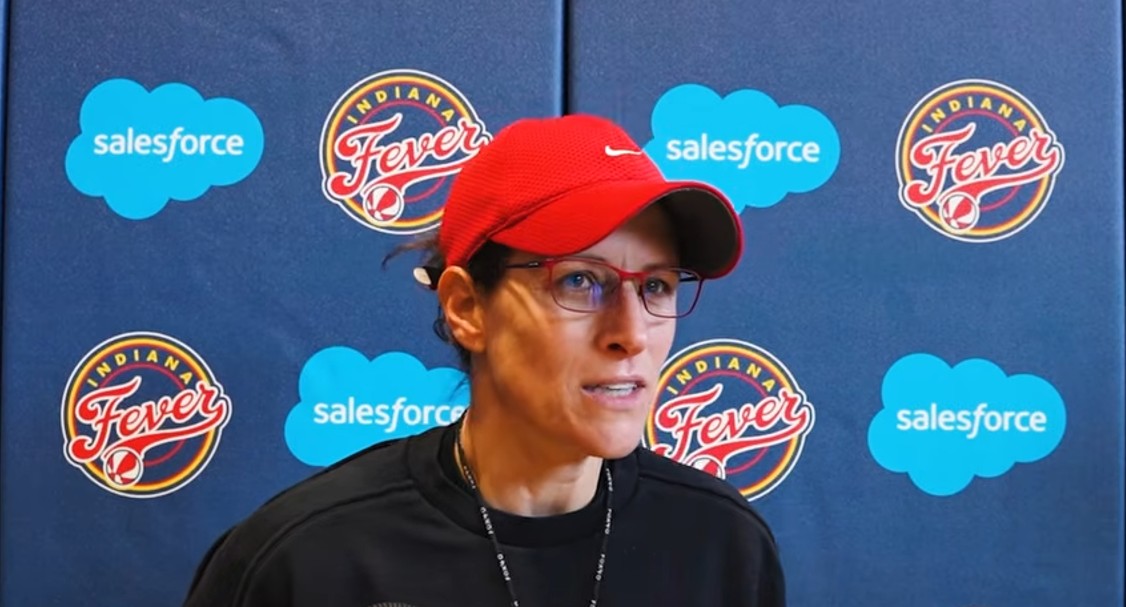
Her first season back in Indianapolis changed the standard. Indiana finished 24-20 in 2025, won the Commissioner’s Cup and reached Game 5 of the WNBA semifinals despite a long injury list that included Caitlin Clark. The Fever eventually lost to the Las Vegas Aces in overtime, but the run established White as far more than the coach hired to manage the attention surrounding Clark.
She had built a team capable of surviving without its biggest star.
The challenge in 2026 is different. Opponents know what Indiana wants to do, expectations have risen and White has spent much of the season making difficult decisions about the health and playing time of Clark, Aliyah Boston and other important players.
As of July, the Fever remain in the playoff race after an uneven but encouraging first half of the season. Clark recently produced the best scoring performance of her professional career, putting up 45 points and 10 assists in a 110-107 victory over the Seattle Storm. Indiana followed that result with a convincing 108-88 win against the New York Liberty.
White called Clark’s performance against Seattle “special,” which was an accurate description without any need to dress it up. Clark became the first WNBA player to finish a game with more than 40 points and at least 10 assists.
For White, the result offered some relief after weeks dominated by injury reports, workload questions and arguments over how physically opponents are allowed to defend Clark.
| Current team | Indiana Fever |
| Current position | Head coach |
| Date of birth | June 20, 1977 |
| Age in 2026 | 49 |
| Birthplace | Danville, Illinois |
| Hometown | West Lebanon, Indiana |
| College | Purdue University |
| WNBA Coach of the Year | 2023 |
| Indiana Fever salary | Not publicly disclosed |
| Partner | ESPN reporter Lisa Salters |
| Children | Four sons in a blended family |
White Is Managing More than Wins and Losses in 2026
White’s most difficult task this season has been deciding how hard to push a roster built to contend for a championship.
Clark has dealt with a recurring back problem after injuries limited her to only 13 games in 2025. Boston has managed inflammation in her right leg. Lexie Hull began the season with hamstring tightness, and Indiana has repeatedly faced stretches containing games on consecutive nights.
White has occasionally rested one star and played another rather than putting both on the floor during a back-to-back. Before games against Los Angeles and Phoenix in July, for example, she announced that Clark and Boston would effectively alternate appearances. Clark played against the Sparks, Boston returned for the following game and Indiana avoided asking either player to carry a full workload on consecutive nights.
Such decisions are rarely popular with ticket holders who paid to see the team’s best players. They are also difficult to explain when the player says she feels capable of playing. The WNBA warned Indiana earlier in the season after Clark was removed from the lineup shortly before a game without first appearing on the required injury report.
White has continued to favor the longer view. Indiana learned in 2025 how quickly a promising season can become an exercise in finding enough healthy players to finish it.
Recent results support some of that caution. Clark returned from her latest absence and scored 45 points in only 29 minutes against Seattle. Her movement looked freer, her shooting rhythm returned and she repeatedly reached the free-throw line. Indiana did not merely get Clark back on the court. It got the aggressive version of Clark that changes how every defender must position herself.
Boston’s availability remains just as important. The center was averaging 17.2 points and 8.7 rebounds through 22 appearances when White rested her against Seattle. Her combination with Clark remains the tactical center of Indiana’s offense, particularly when the Fever can surround their pick-and-roll game with reliable outside shooting.
Kelsey Mitchell has given White another dependable scorer. Mitchell was named Eastern Conference Player of the Week in July after helping Indiana win four of five games. White delivered the announcement during practice, drawing immediate applause from the rest of the team.
How Much Does Stephanie White Earn?
White’s exact salary has not been released by the Indiana Fever or the WNBA.
Several websites claim that she earns around $500,000 per season, but that number has not been confirmed in a team announcement, league document or reliable contract report. Other sites publish much larger figures without identifying where the information came from.
The honest answer is less exciting but more accurate: White’s annual salary and the total value of her Indiana contract remain private.
WNBA player salaries are governed by the collective bargaining agreement and are regularly reported alongside roster and salary-cap information. Coaching contracts do not operate under the player salary cap, and teams are not required to publish their terms.
Readers accustomed to the detailed figures available for NBA player salaries will not find the same paper trail for WNBA coaches. Indiana did not disclose White’s salary or the length of her agreement when it announced her return in November 2024.
The secrecy creates room for unsupported salary and net-worth estimates. No reliable public record establishes White’s net worth either, so claims that assign her a fortune of several million dollars should be treated as guesses.
One revealing moment came after Indiana won the 2025 Commissioner’s Cup. The players divided a $500,000 prize pool, but the competition did not provide White with a share. Asked what she would have done with a bonus, the mother of four gave a practical answer: it would have gone into the college fund.
Indiana Basketball Knew White Long Before the Fever Hired Her
White was born in Danville, Illinois, but grew up in West Lebanon, Indiana. Her connection to basketball in the state began well before her professional career.
At Seeger High School, she scored 2,869 points and once recorded 66 in a single game. White was named Indiana Miss Basketball in 1995, along with receiving national high school player of the year honors from Gatorade and USA Today.
She stayed in Indiana to attend Purdue, where her career became part of the history of the women’s program. White averaged 17.2 points, 5.3 rebounds and 4.6 assists during four seasons and finished with 2,182 career points.
Her senior season remains the one people remember. Purdue went 34-1 and won the 1999 NCAA championship. White averaged 20.2 points and 4.5 assists, earning the Wade Trophy, the Honda Sports Award and Big Ten Player of the Year honors.
The numbers only tell part of her college story. White also completed a communications degree, earned Academic All-America recognition and became a member of Phi Beta Kappa. Purdue later inducted her into both its Academic All-America Hall of Fame and its athletics hall of fame.
Her Playing Career Brought Her Back to Indiana
White entered the WNBA in 1999 and spent her first season with the Charlotte Sting. Indiana acquired her before the Fever’s inaugural season in 2000, beginning a relationship with the organization that has now covered playing, assistant coaching and two separate periods as head coach.
She played four seasons for the Fever and finished her Indiana career with 684 points, 225 assists, 115 steals and 92 made three-pointers in 112 games. Injuries contributed to her retirement in 2004.
White was never the most physically imposing guard in the league. Her game relied on preparation, spacing and reading defenders. The same qualities later became visible in her coaching.
She began coaching in college as an assistant at Ball State, Kansas State and Toledo. The Chicago Sky brought her into the WNBA as an assistant in 2007, and she returned to Indiana as part of Lin Dunn’s staff in 2011.
The Fever won the WNBA championship the following year. White became associate head coach and eventually replaced Dunn as head coach before the 2015 season.
| Years | Team | Position | Notable result |
|---|---|---|---|
| 2003-2004 | Ball State | Assistant coach | Beginning of coaching career |
| 2004-2005 | Kansas State | Assistant coach | College coaching experience |
| 2005-2007 | Toledo | Assistant coach | Final college assistant role before WNBA |
| 2007-2010 | Chicago Sky | Assistant coach | Returned to the WNBA |
| 2011-2014 | Indiana Fever | Assistant and associate head coach | Won the 2012 WNBA championship |
| 2015-2016 | Indiana Fever | Head coach | Reached the 2015 WNBA Finals |
| 2016-2021 | Vanderbilt | Head coach | Returned to college basketball |
| 2023-2024 | Connecticut Sun | Head coach | 55-25 record and two semifinal appearances |
| 2025-present | Indiana Fever | Head coach | 2025 Commissioner’s Cup and WNBA semifinals |
Her First Fever Team Came Within One Win of A Championship
White became the first rookie head coach in WNBA history to lead a team into the Finals when Indiana reached the championship series in 2015.
The Fever lost to the Minnesota Lynx in five games, but White finished her first two seasons as an Indiana head coach with a 37-31 regular-season record and a 6-6 playoff record. Both teams reached the postseason.
Her departure after 2016 was not the end of her coaching career. White accepted the head coaching position at Vanderbilt, where she remained through 2021. The results were mixed, and her time in Nashville did not produce the same success she had experienced in the WNBA.
Connecticut gave her another professional opportunity in 2023. White responded immediately, leading the Sun to a 27-13 record and receiving the WNBA Coach of the Year award.
Connecticut went 28-12 the following season. White’s two Sun teams had a combined 55-25 record and reached the semifinals both years.
Returning to Indiana Also Brought Her Closer to Her Family
White’s move from Connecticut was partly a basketball decision and partly a family decision.
She and her partner, longtime ESPN reporter Lisa Salters, have a blended family with four sons. Their primary home is in Nashville. Coaching in Connecticut required White to spend long stretches away, particularly after the children returned to school and the WNBA playoffs began.
Travel between Nashville and Uncasville was awkward. There was no convenient direct flight, and the journey continued by road after landing. White told reporters that she could go months seeing very little of her children during the busiest part of the season.
Indiana did not put her in the same city as her family, but Indianapolis was considerably closer. White already knew the organization, the state and many of the people responsible for rebuilding the Fever.
Family also helps explain why she has maintained a career in television. White has worked as a basketball analyst for ESPN, the Big Ten Network and regional broadcasts covering the Indiana Pacers. Broadcasting allowed her to remain connected to the game during periods when she was not coaching.
The 2025 Season Changed how White Is Judged
Caitlin Clark played only 13 games in 2025, and Indiana eventually lost six players to season-ending injuries. A season that had started with championship ambitions could easily have collapsed.
It did not.
The Fever won the Commissioner’s Cup without Clark, defeating the Minnesota Lynx 74-59 in Minneapolis. They finished the regular season 24-20, eliminated the Atlanta Dream in the opening playoff round and took Las Vegas to overtime in the deciding fifth game of the semifinals.
Kelsey Mitchell was injured during that final game, Boston fouled out and Clark watched from the bench. Indiana still had a chance to reach the Finals in the final minutes of regulation.
White’s reputation benefited from the run because the Fever no longer looked dependent on one player. Clark remained central to their future, but Indiana could defend, change lineups and find points elsewhere when she was unavailable.
What White Must Solve Before the 2026 Playoffs
The latest run of games has shown both versions of the Fever.
Indiana can score quickly enough to overwhelm a strong opponent, as it did against New York. Clark and Mitchell can punish defenses from outside, Boston can control the paint and White has enough lineup options to change the pace of a game.
Health remains the question hanging over every promising result.
White must decide when to rest Clark, how carefully to manage Boston and how much regular-season urgency is worth the risk of arriving in the playoffs with another depleted roster. She also has to keep the Fever focused when every disagreement, technical foul and injury decision involving Clark becomes national news.
A championship cannot be won in July, but it can be made much harder to win if a coach ignores the warning signs in July. White learned that during the 2025 season.
Her salary may remain hidden, but her job in 2026 is visible every night. Indiana expects to play deep into the postseason, and White is responsible for getting its best players there healthy enough to finish what last year’s team started.