
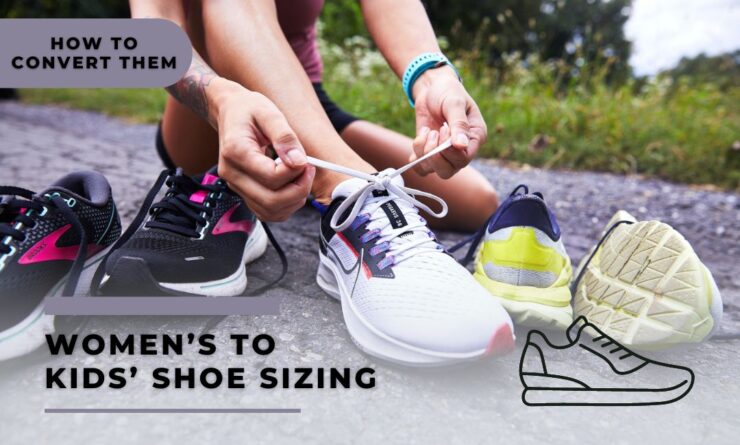
The short answer: women’s size minus 1.5
To convert a women’s US shoe size to a kids’ size, subtract 1.5. A women’s 8 is a 6.5Y. A women’s 7 is a 5.5Y. This is the ratio Nike, Jordan, adidas, New Balance, Vans and Under Armour use, and you can verify it yourself: on Nike’s own charts, a 7Y and a women’s 8.5 are both EU 40 and UK 6.
Two things nobody tells you up front, and both of them matter more than the formula:
- Kids’ sizes stop at 7Y, which is roughly a women’s 8.5. If you wear a women’s 9 or larger, there is no kids’ equivalent. The conversion simply runs out.
- Converse, Crocs and Clarks use minus 2, not minus 1.5. Same women’s 8, different answer: a 6Y. Applying the wrong brand’s rule puts you a third of an inch off.
If you want to skip the arithmetic entirely, measure your foot in centimetres and match that number to the brand’s chart. Length is length. It works across every brand, every size system, and it never runs out.
Jump to
- Why women buy kids’ shoes in the first place
- Full women’s to kids’ conversion chart
- Brand-by-brand: minus 1.5 or minus 2?
- How to measure your own feet
- Where kids’ shoes differ beyond length
- When kids’ shoes are a bad idea for adults
- Sizing shoes for actual children
- FAQs
Why women buy kids’ shoes in the first place
Almost nobody searches for this conversion out of curiosity. There are three real reasons, and knowing which one applies to you changes what you should do next.
Price. The grade-school version of a sneaker typically retails well below the adult version of the same silhouette, even when the upper and the sole unit look identical. On a shoe you rotate a few times a week, that gap adds up fast.
Availability. Hyped releases often sell through in adult sizes while grade-school sizes sit on the shelf. Women who land in the 5 to 8.5 range have a second inventory pool that most shoppers never check. Sneaker culture has run on this trick for years, and it is part of why certain signature basketball lines feel impossible to buy on release day in one size run and easy in another.
Fit. A smaller subset of women genuinely fit kids’ lasts better — narrow heels, lower instep, small foot volume. For them it is not a workaround, it is the better shoe.
Those three motivations pull in different directions. If you are here for price, a half-size compromise is probably fine. If you are here because a kids’ last actually fits your foot, precision matters much more.
Full women’s to kids’ shoe size conversion chart
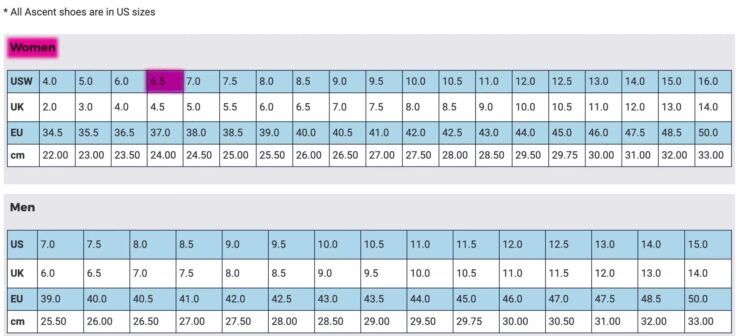
The figures below are foot length, not shoe length. That distinction trips people up constantly: the “CM” printed on the side of a shoebox is the length of the shoe’s interior last, which is longer than your foot. Nike says so explicitly on its own size guide. Measure your foot, then use the foot-length column.
| Women’s US | Foot length (cm) | Foot length (in) | Kids’ size — minus 1.5 brands | Kids’ size — minus 2 brands | UK | EU |
|---|---|---|---|---|---|---|
| 5 | 21.6 | 8 1/2 | 3.5Y | 3Y | 2.5 | 35.5 |
| 5.5 | 22.0 | 8 5/8 | 4Y | 3.5Y | 3 | 36 |
| 6 | 22.5 | 8 7/8 | 4.5Y | 4Y | 3.5 | 36.5 |
| 6.5 | 23.0 | 9 1/8 | 5Y | 4.5Y | 4 | 37.5 |
| 7 | 23.5 | 9 1/4 | 5.5Y | 5Y | 4.5 | 38 |
| 7.5 | 23.8 | 9 3/8 | 6Y | 5.5Y | 5 | 38.5 |
| 8 | 24.1 | 9 1/2 | 6.5Y | 6Y | 5.5 | 39 |
| 8.5 | 24.6 | 9 11/16 | 7Y (largest kids’ size) | 6.5Y | 6 | 40 |
| 9 | 25.0 | 9 7/8 | none | 7Y (largest kids’ size) | 6.5 | 40.5 |
| 9.5 | 25.4 | 10 | none | none | 7 | 41 |
| 10 | 25.9 | 10 3/16 | none | none | 7.5 | 42 |
The pattern is simple once you see it. Each full US size step is one third of an inch, roughly 8.5 mm — a figure that goes back to the Brannock Device and has been the industry’s yardstick since the 1920s. That is why half a size is such a small margin: about 4 mm, less than the thickness of a winter sock.
Brand by brand: minus 1.5 or minus 2?
Search this topic and you will find confident articles telling you to subtract 1.5 and equally confident articles telling you to subtract 2. Both are right, for different brands, and the reason is structural rather than arbitrary.
Some brands number their youth line off the men’s scale. Since those brands treat women’s as men’s plus 2, the women’s-to-youth gap is also 2. Other brands number youth off the Brannock youth scale, where the gap works out to 1.5. Nothing about the shoe changes — only the number printed inside it.
| Brand | Rule | Women’s 8 becomes |
|---|---|---|
| Nike / Jordan | Subtract 1.5 | 6.5Y |
| adidas | Subtract 1.5 | 6.5Y |
| New Balance | Subtract 1.5 | 6.5Y |
| Vans | Subtract 1.5 | 6.5Y |
| Under Armour | Subtract 1.5 | 6.5Y |
| Converse | Subtract 2 | 6Y |
| Crocs | Subtract 2 | 6Y |
| Clarks | Subtract 2 | 6Y |
Treat this as a starting point rather than gospel. Brands revise their lasts, and outdoor and comfort labels in particular sit outside both rules. UGG is a well-known outlier: its big-kid 5 lines up with a women’s 6.5, which is neither minus 1.5 nor minus 2. Sizes also drift between models within a single brand, which is exactly why the centimetre column beats the formula every time.
How to measure your own feet properly
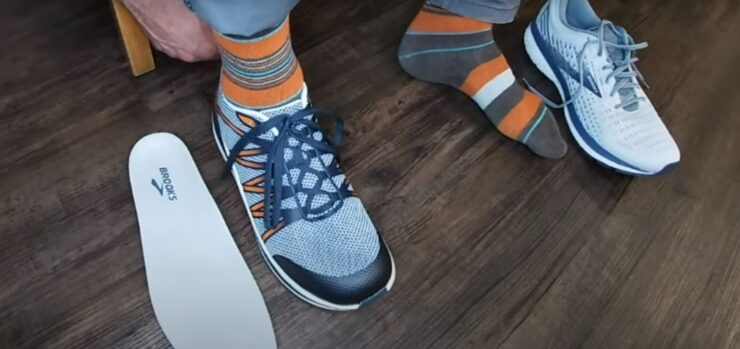
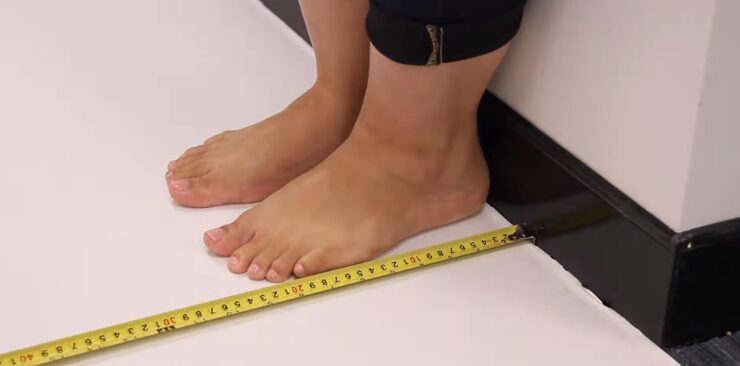
Six or seven minutes with a sheet of paper will beat any conversion formula. Length is measured heel to longest toe, and the longest toe is not always the big toe.
- Measure in the late afternoon or evening. Feet swell over the course of a day, and the difference between a morning and an evening measurement is often half a size. Fit the foot at its largest.
- Wear the socks you will actually wear with the shoe. A cushioned running sock and a thin dress sock are not the same shoe.
- Tape paper to a hard floor against a wall. Carpet distorts the trace. Stand with your heel touching the wall and your weight evenly on both feet — standing, not sitting, because the foot lengthens under load.
- Mark the tip of the longest toe with the pencil held vertically, not angled. An angled pencil adds several millimetres.
- Measure both feet and use the larger one. Asymmetry of half a size is completely normal.
- Add 5 to 10 mm of toe room to your longest measurement, then match that total to the brand’s chart.
Then check width. On the US system, each width step is 3/16 of an inch. Women’s shoes are commonly offered in B (standard) and D (wide); kids’ shoes are usually medium only. If you normally buy a wide, this is the point at which the kids’ route probably stops making sense for you.
Where kids’ shoes differ from women’s beyond length
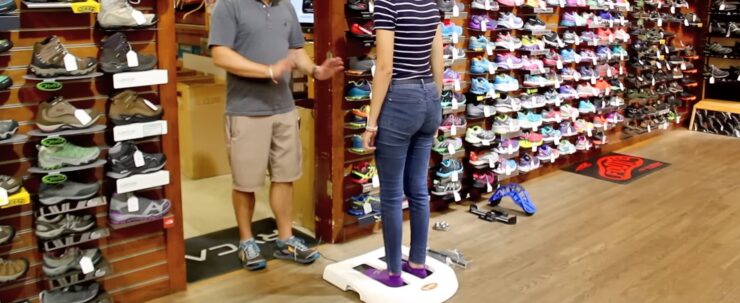
This is the part most conversion guides skip, and it is where people get burned. Matching the length is necessary but not sufficient — a 6.5Y and a women’s 8 are the same length and still not the same shoe.
The last shape is different. Kids’ lasts are built straighter and roomier through the forefoot, because growing feet are proportionally wider at the toes. The heel cup is often narrower. If you have a broad forefoot and a slim heel, this can be an upgrade. If you have the opposite, you will slide.
Midsole foam is tuned for lighter bodies. Cushioning in a performance shoe is calibrated to a target weight range, and grade-school models are built for children who weigh substantially less than an adult woman. Put an adult’s mass and stride force on that foam and it compresses further, bottoms out sooner, and loses its rebound faster. For a casual sneaker this is irrelevant. For a running shoe covering real mileage, it is the whole ballgame.
Support features get simplified. Grade-school versions of adult silhouettes are frequently built with different materials or a reduced feature set — fewer stability elements, simpler outsole rubber, occasionally a different foam compound. They look the same on a product page. They are not always the same shoe.
Heel-to-toe drop can vary between the two versions. Drop is the height difference between the heel and forefoot, and it changes how load travels through your calf and Achilles. If you have adapted to a specific drop, an unannounced change is a common source of new niggles.
When you should not buy kids’ shoes as an adult
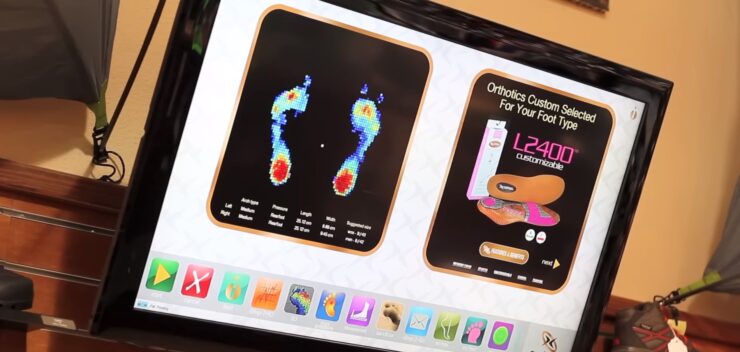
Being able to fit into a 7Y does not mean you should. Skip the kids’ section if any of the following apply.
- You run meaningful mileage. The midsole issue above is not theoretical; you will feel the cushioning die early and you will replace the shoe sooner, which erases the price advantage.
- You wear orthotics. Kids’ shoes rarely have a removable footbed with enough volume underneath to accept a custom device without cramping the toe box.
- You have diagnosed foot pathology — plantar fasciitis, bunions, hammertoes, diabetes-related neuropathy. Fit tolerances shrink dramatically, and a compromise fit is not a compromise you can afford.
- You need a width other than medium. The option usually is not there.
- You are shopping for anything other than a sneaker. Boots, dress shoes and hiking footwear have last geometry that does not translate at all between the two categories.
- You are between half sizes. A woman who is genuinely an 8.25 has a 6.5Y and a 7Y to choose from and will be marginally wrong in both directions. Buy the adult size.
The cost of getting this wrong is not just discomfort. A systematic review of the literature by Buldt and Menz, published in the Journal of Foot and Ankle Research, found that between 63 and 72 percent of participants across 18 studies were wearing shoes that failed to accommodate the length or width of their feet — and linked poor fit to foot pain and deformity. The American Academy of Orthopaedic Surgeons associates chronically ill-fitting footwear with bunions, hammertoes and ingrown toenails.
Sizing shoes for actual children
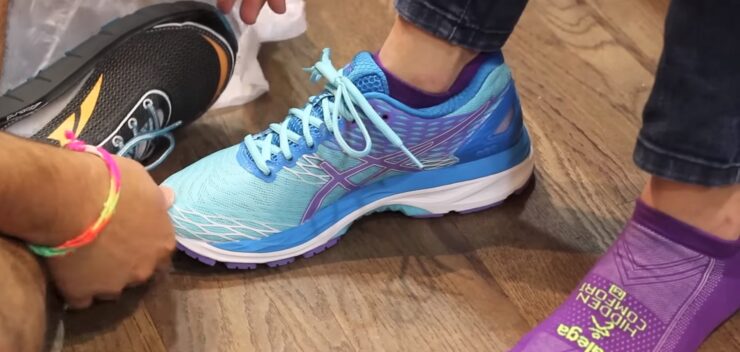
If you arrived here as a parent rather than a shopper, the priorities flip. The conversion barely matters; the measurement schedule is everything.
First, understand the two kids’ size bands, because they are numbered separately and this causes endless confusion:
| Band | Label | US range | Rough age |
|---|---|---|---|
| Toddler / little kid | C (e.g. 10C) | 1C to 13C, then 1 to 3 | 1 to 7 years |
| Big kid / grade school / youth | Y (e.g. 6Y) | 3.5Y to 7Y | 8 to 12 years |
Note that the numbering restarts. A 13C is followed by a 1Y, not a 14C — and a 1Y is a completely different shoe from a 1C. The women’s conversion in this article applies only to the Y band. It does not work for C sizes.
Kids’ sizes are also unisex through the entire Y range. There is no separate boys’ and girls’ scale; a 6Y is a 6Y. Colourways are marketed by gender, lasts generally are not.
Growth rate is what drives everything else. Between the ages of roughly three and six, children’s feet gain around half an inch a year, and growth comes in bursts rather than steadily. Because a full size step is only a third of an inch, a child can outgrow a shoe in a couple of months without anything visibly changing. Younger children grow faster still. Measure every two to three months up to about age six, and every three to four months after that.
Watch the arch too. Arches typically form during childhood, and flat-looking feet in a toddler are usually normal development rather than a problem to be corrected with aggressive arch support.
One thing worth saying plainly: children frequently will not tell you a shoe is too small. Young feet are soft and adaptable enough to curl into a short shoe without registering it as pain, which is precisely why measurement beats asking. Do not wait for a complaint.
Fitting kids’ shoes accurately: a checklist
- Measure both feet, late in the day, standing. Same rules as adults, same reasons.
- Leave about a thumb’s width of growing room — roughly 10 to 12 mm past the longest toe. More than that and the shoe’s flex point sits in the wrong place, which is its own problem.
- Press across the widest part of the forefoot. You want the child’s toes to splay, not stack. Width is the most commonly missed dimension.
- Check the heel. Snug, no slipping when they walk, but not gripping hard enough to leave a mark.
- Bend the shoe. It should flex at the ball of the foot, not fold in half at the middle. A shoe that folds anywhere it likes is not supporting anything.
- Watch them walk in it. Thirty seconds of observation catches problems that no chart will.
If you can, get the first pair of a new size band fitted in person at a shop with trained staff. After that, the at-home method is perfectly adequate for restocking the same model.
How to read a shoe size chart
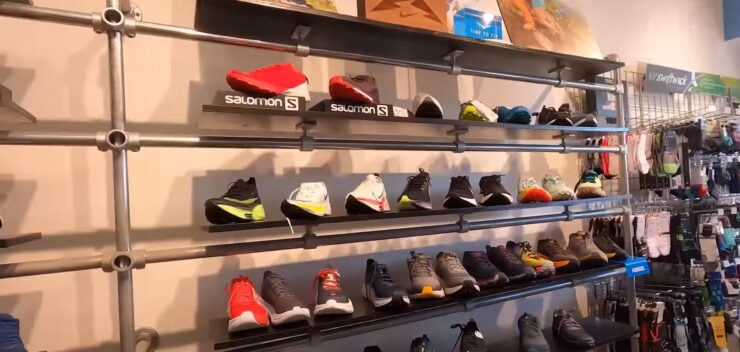
Most size charts have three or four columns and one hidden trap. Here is a typical layout:
| Foot length (in) | Foot length (cm) | Women’s US | Kids’ US |
|---|---|---|---|
| 8 7/8 | 22.5 | 6 | 4.5Y |
| 9 1/4 | 23.5 | 7 | 5.5Y |
| 9 1/2 | 24.1 | 8 | 6.5Y |
| 9 11/16 | 24.6 | 8.5 | 7Y |
The trap is the centimetre column. Some brands publish foot length; others publish shoe length, sometimes labelled JP or “CM” on the box. The two differ by roughly a centimetre. If a chart’s numbers look about one size off from what you measured, you are almost certainly reading the wrong one — check the column heading before you blame your tape measure.
Better charts also show width codes. The US system runs AAA, AA, A, B, C, D, E, EE, EEE, with each step 3/16 of an inch apart and the actual width varying with foot length. A B in a size 6 is not the same absolute width as a B in a size 10.
Online conversion tools and calculators
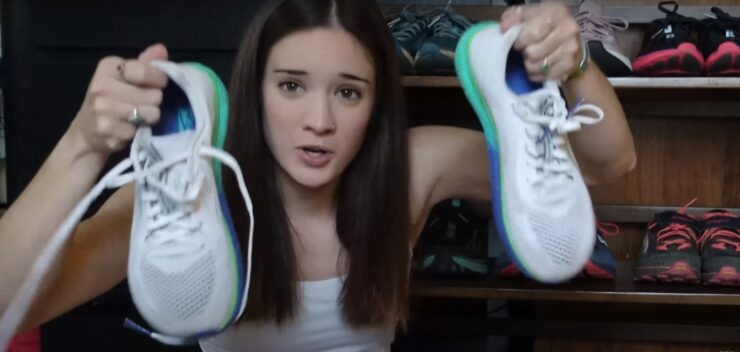
Conversion calculators are convenient, but they are only as good as the chart behind them — and most of them apply one generic rule across every brand, which is exactly the error this article exists to fix.
The tools worth using are the ones the manufacturers publish themselves. Nike, adidas, New Balance and Vans all host size guides with foot-length columns in centimetres for both their women’s and grade-school lines, and several offer printable measuring guides. Because those charts come from the same company that built the last, they are the only source that is definitionally correct for that shoe.
Whatever tool you use, three rules apply:
- Feed it a real measurement, not your usual size. Garbage in, garbage out.
- Check which brand it was built for. A calculator tuned to Converse will mis-size you at Nike by half a size.
- Confirm it is using foot length, not shoe length, in the centimetre field.
FAQs
What size in kids is a women’s 8?
A 6.5Y at Nike, Jordan, adidas, New Balance, Vans and Under Armour, which use the minus 1.5 rule. A 6Y at Converse, Crocs and Clarks, which use minus 2. Both correspond to a foot length of roughly 24.1 cm.
What is the largest kids’ shoe size?
7Y is the top of the big-kid range in the US system, equivalent to about a women’s 8.5 or a foot length of 24.6 cm. If you wear a women’s 9 or above, there is no kids’ equivalent at most brands.
Is a women’s 7 the same as a kids’ 5?
At Converse, Crocs and Clarks, yes. At Nike, adidas, New Balance and Vans, a women’s 7 is a 5.5Y — a kids’ 5 would be roughly a third of an inch too short. Check the brand before you order.
Do kids’ shoes run narrow?
Kids’ shoes are usually built roomier through the forefoot and narrower at the heel than the equivalent women’s shoe, and they are typically offered in medium width only. Women with wide forefeet often do well in them; women who need a D width usually do not.
Are boys’ and girls’ shoe sizes different?
No. Kids’ shoe sizing is unisex throughout the toddler (C) and big-kid (Y) ranges. A 6Y is a 6Y regardless of who it is marketed to. Only the colourways and styling differ.
Can I use this conversion for toddler sizes?
No. The conversion applies only to big-kid sizes labelled with a Y. Toddler and little-kid sizes labelled C use a separate scale that restarts at 1, and no women’s equivalent exists.
Why are kids’ shoes cheaper than the same adult model?
They use less material, and manufacturers price the grade-school line for a market that outgrows shoes within months. The savings are real, but so are the construction differences — grade-school versions of adult silhouettes sometimes use different foams or a simplified feature set.
How do I determine the shoe size for my child?
Measure both feet heel to longest toe, standing, late in the day, and use the longer measurement. Add about 10 to 12 mm of growing room, then match the total to the brand’s chart. Do not size by age.
How often should I measure my child’s feet?
Every two to three months up to about age six, and every three to four months after that. Because one US size step is only a third of an inch, a child can outgrow a shoe between measurements without any outward sign.
Should I choose shoes based on my child’s age or shoe size?
Always shoe size. Age ranges on size charts are averages across an enormous spread, and a measured foot is the only figure that means anything.
Sources and further reading
- Buldt AK, Menz HB. Incorrectly fitted footwear, foot pain and foot disorders: a systematic search and narrative review of the literature. Journal of Foot and Ankle Research, 2018.
- The Brannock Device Company — US sizing increments and width system.
- Smithsonian Lemelson Center: Charles F. Brannock and the standardisation of foot measurement.
- American Academy of Orthopaedic Surgeons — footwear and foot deformity.
- American Podiatric Medical Association — foot health resources.
- FamilyDoctor.org — arch development in children.
This article is general information, not medical advice. If you have foot pain, a diagnosed foot condition, or diabetes, speak to a podiatrist before changing your footwear.
<!– ============================================================
FAQ SCHEMA (JSON-LD)
Add via your SEO plugin’s schema field, a custom HTML block,
or a code-snippets plugin. WordPress’s visual editor may strip